The ultra-compact fourth axis is suited to mounting BT30-taper machining centre tables, but provides manufacturers with a larger machining envelope on any size of machine. The thin profile also makes the NC table ideal for use with an opposing trunnion for securing and rotating a workpiece between centres in limited working areas. If so, it may be orientated in the horizontal or vertical plane.
Detailed specifications include a 114 mm diameter table, 65 mm through-hole (for the CK160), 140 mm centre height, 340 Nm pneumatic clamping and 41.6 rpm maximum rotating speed. Indexing accuracy is 20 arc-seconds, with 4 arc-seconds repeatability. Workpieces up to 160 kg can be supported when the table is mounted horizontally, or 80 kg in the vertical.
The second new product is a small power chuck with quick-change jaws, the QJR 07. The unit joins the existing QJR 08,10 and 12 models, all of which are interchangeable with the company's large, through-hole B and BB series. QJR chucks avoid the need for long-stroke cylinders or a reduction in gripping force. (Video above shows QJR chucks in general)
The latest QJR 07 has a maximum gripping force of 60 kN, a 53 mm through-hole and can be run at up to 6,000 rpm.
Manufactured from high grade alloy steel, the units have base jaws that are rapidly and simply changed using a manually-operated wrench. The units feature metric serrations to accommodate a wide variety of popular jaw types, including standard Kitagawa soft jaws. The chucks are, therefore, ideal for small and large batch production.
The last of the trio of new introductions are rests for shaft machining on lathes and grinding machines.
The wide range boasts a high level of build quality to ensure accuracy and safety on the shopfloor. Different versions encompass fixed or travelling positioning, vertical loading, crank shaft turning, models with an actuating cylinder, compact designs for restricted work areas and heavy duty models for components weighing up to 40 tonnes.
Elsewhere on the stand, will be an Iemca Boss 21 bar magazine, which can be used with both sliding-head and fixed-head lathes. A compact model for feeding bar from 5 to 51 mm in diameter and with a maximum length of just over 2 m, it is said to be ideal if a long barfeeder is required but space restricted. Less material is lost through remnants than if a shorter bar is used and longer periods of unattended running are possible.
The unit is actuated by an asynchronous motor, with the position of the stock is encoder controlled, while the remnant collector is at the rear of the magazine, together with the oil tank.
A second Iemca barfeeder will be on show, the established KID 80, suitable for all types of single-spindle lathe, whether fixed- or sliding-head, CNC or cam-controlled. It can accept bar diameters from 5 to 80 mm and in lengths from just 90 mm to a maximum of 1,615 mm. Operation is entirely mechanical, without the need for a compressed air connection, assuring reliable performance and efficiency.
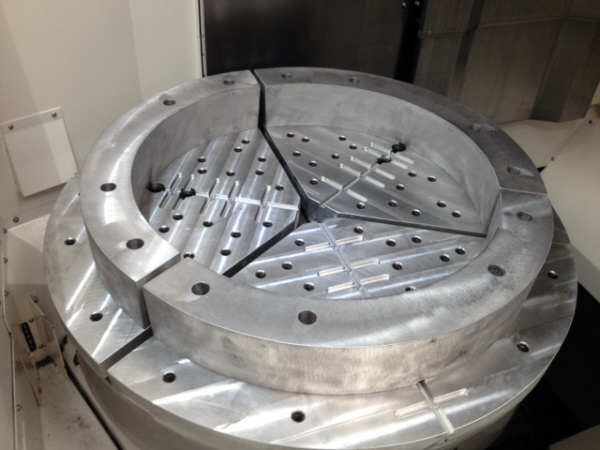
On
show for the first time in the UK will be a master plate and segment
system from US firm Abbott. Ideal for turning larger diameter
workpieces, the arrangement consists of an aluminium master plate,
similar to a thin pie jaw, which is pre-drilled and keyed to accommodate
Abbott's standard, off-the-shelf segment rings.
- See more at:
http://www.machinery.co.uk/machinery-news/1st-machine-tool-accessories-kitagawa-workholding/60356/#sthash.okkdZJ5s.dpuf
- See more at: http://www.machinery.co.uk/machinery-news/1st-machine-tool-accessories-kitagawa-workholding/60356/#sthash.okkdZJ5s.dpuf
No comments:
Post a Comment